Deep-cleaning guide
Why deep cleaning matters for a healthy home
Deep cleaning matters when routine maintenance no longer reaches the detail that has built up around appliances, cupboards, skirting, fittings and other low-frequency areas. The practical benefit is a clearer household baseline. It should not be sold as a medical treatment or as a substitute for fixing damp, leaks or other building problems.

Is deep cleaning worth it?
It can be worth it when the home needs a detailed reset rather than ordinary recurring maintenance. Deep cleaning is most useful when low-frequency areas have accumulated work, when the household is establishing a new cleaning routine, or when inside-appliance, cupboard, skirting and detailed fitting tasks need to be dealt with together.
It is not automatically necessary on a fixed calendar. The condition of the property and the task list are better guides than a universal “deep clean every X months” rule.
Five practical signs routine cleaning is no longer enough.
These are cleaning-scope signals, not medical diagnoses.
Low-frequency areas have become a separate job.
Skirting, door frames, detailed fittings, inside storage or accessible vents may no longer fit comfortably inside the normal maintenance visit.
Inside ovens, fridges or cupboards need deliberate time.
These tasks can dominate a standard visit if they are added casually rather than scoped as detailed work.
Routine wiping is not addressing the visible detail.
Significant limescale or accumulated grime can need a different task sequence and suitable product choice.
The household wants to restart regular cleaning from a clearer condition.
A one-off detailed reset can make the recurring brief simpler afterwards.
There has been a period of disruption or reduced maintenance.
Renovation dust, prolonged absence, illness in the household or a very busy period may leave more detailed cleaning than the normal routine can absorb.
What “healthy home” can and cannot mean on a cleaning page.
A clean, well-maintained home can reduce visible dirt and help household routines, but a cleaning company should not promise to prevent illness. The Health and Safety Executive notes that cleaning products themselves can create exposure risks if used incorrectly, including skin irritation, allergies, asthma or corrosive injury. Safe product use and ventilation matter alongside the cleaning result.
Damp and mould also need a cause-first approach. NHS-linked guidance on damp and mould recommends dealing with moisture sources, leaks and ventilation rather than relying only on repeated surface treatment. If the underlying issue is a building defect, cleaning alone is not the solution.
How often should you deep clean?
There is no evidence-based universal frequency that fits every London household.
Frequency changes with the property, occupancy, pets, cooking, children, ventilation, the amount of routine cleaning and which tasks the household defines as “deep”. A home with effective regular cleaning may need detailed work only occasionally; another household may choose targeted deep-clean tasks more often.
A better method is to keep a recurring maintenance list and a separate low-frequency list. When the second list becomes too large to fit around normal cleaning, decide whether to book a focused deep clean.
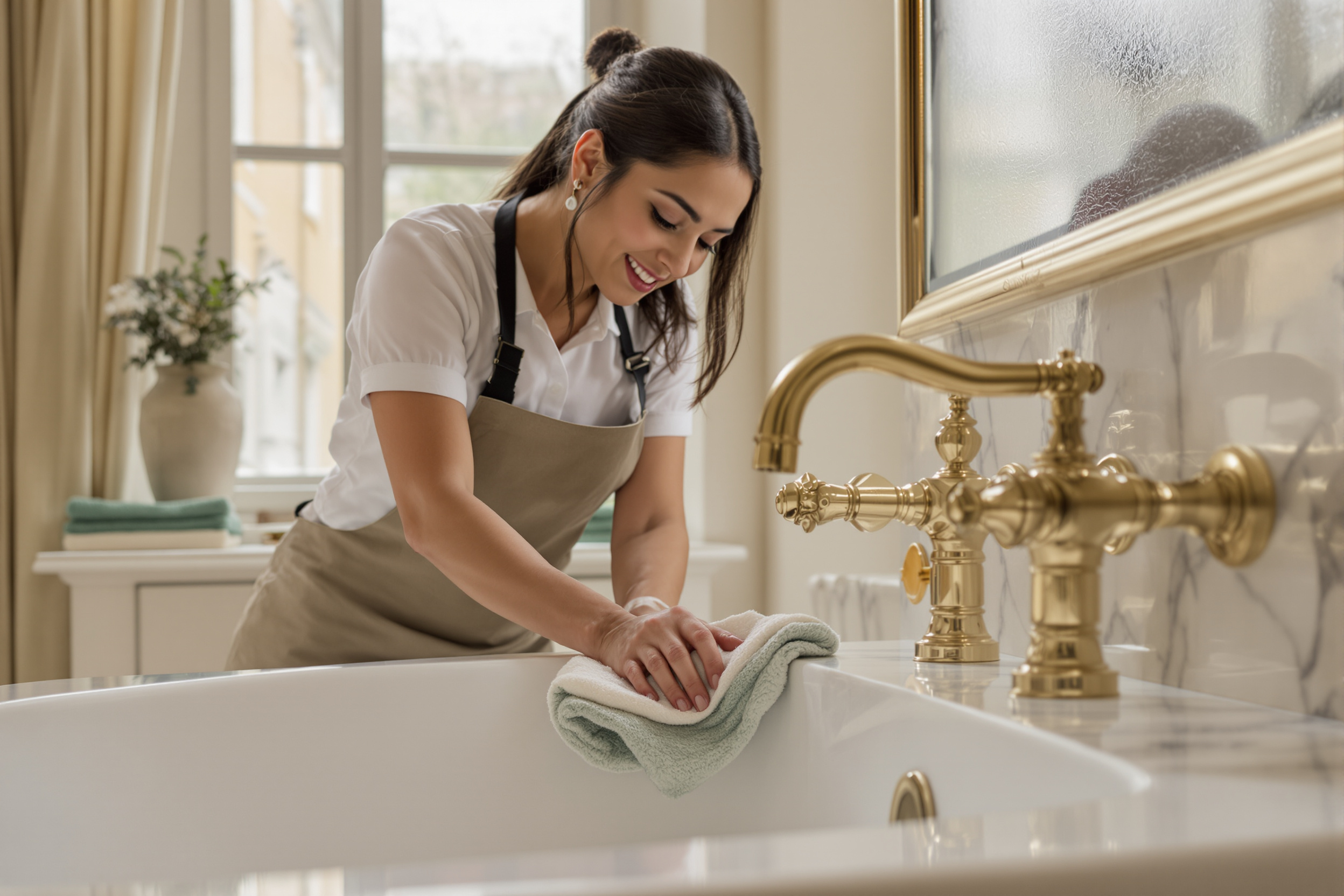
From our work: we separate maintenance tasks from low-frequency detail.
The previous Filipino Domestic Services cleaning pages used two different task patterns. Regular cleaning focused on repeatable work such as dusting, vacuuming, mopping, bathrooms, kitchen surfaces and general tidying. Deep cleaning added a more detailed layer including appliances, cupboards, skirting, doors, switches, windows and other lower-frequency areas.
That difference is more useful than a calendar rule. It lets a household ask a simple question: is the task part of the normal maintenance cycle, or has it become a separate detailed job? If the household keeps adding deep-clean work into every regular visit, the recurring brief eventually stops describing what can realistically be done.
The rebuilt site therefore treats deep cleaning as a scope decision. We do not publish a fixed “healthy home” frequency, a disease-prevention promise or an invented hygiene percentage. The household can compare the actual low-frequency list with the regular-cleaning list and choose a one-off deep clean when the detailed work justifies it.
That also makes the next step clearer: after the reset, return to a simpler recurring schedule if ongoing maintenance is what the home needs.
That separation also prevents the educational article from inventing a medical reason to sell the service: the decision remains a cleaning-scope decision grounded in the household task list.
What should you do after a deep clean?
Identify which tasks genuinely need regular repetition and move those into a maintenance schedule. If the home needs ongoing support, book regular domestic cleaning with a narrower repeatable list. If the property currently needs the reset itself, arrange a one-off deep clean.
If you are still deciding between service types, compare home-cleaning services before requesting a quote.
Deep-cleaning guide questions.
Is deep cleaning necessary for every home?
No. It is useful when the property has detailed or accumulated work outside the normal maintenance list. A home that is already well maintained may need only occasional targeted deep-clean tasks.
How often should a house be deep cleaned?
There is no universal evidence-based interval for every household. Property size, occupancy, pets, cooking, routine maintenance and which tasks you classify as deep cleaning all affect the practical frequency.
Can deep cleaning prevent illness?
This page does not make that claim. Cleaning can remove visible dirt and support household hygiene, but health outcomes depend on many factors. Product safety, ventilation and underlying building issues also matter.
Does deep cleaning solve damp and mould?
Not necessarily. Surface cleaning may remove visible mould in some situations, but persistent damp or mould can come from leaks, condensation or ventilation problems. The moisture source should be identified and addressed.
What is usually outside regular cleaning but inside a deep clean?
Examples can include inside agreed appliances or cupboards, detailed skirting, door frames, switches, accessible vents and other lower-frequency areas. The exact scope should be confirmed for the property.
Should I deep clean before starting regular cleaning?
Only if the property needs that reset. If the home is already at a maintainable baseline, regular cleaning can begin without adding an unnecessary separate service.
Sources and evidence boundary.
The service distinction is grounded in the FDS regular and deep-clean task lists. Health and product-safety statements are intentionally narrow and use current HSE and NHS-linked guidance.
Compare the task list with your normal routine.
If the detailed work has become a separate job, move from the guide into the appropriate cleaning service.